Building a Temperature and Humidity Logger
This project came from a much simpler idea than some of my other recent builds. The goal was to build a temperature and humidity logger that stayed inexpensive, easy to assemble, and practical enough to reproduce many times. That simplicity ended up becoming the most important part of the entire project, because it made the design feel less like a one-off experiment and more like something I could actually deploy at scale.
I wanted a device that was small, affordable, and easy to maintain, because those qualities matter much more when you start thinking about more than one node. A design like this does not need to be flashy to be useful. It just needs to gather reliable readings, display them clearly, and do it in a way that is realistic to duplicate without spending too much money or time on every unit.
GitHub Copilot still played a useful role during development, especially when I needed help shaping parts of the firmware and speeding up the more repetitive parts of coding. Since this project was intentionally simple, the real challenge was not adding features but keeping the implementation clean. I still tested everything on real hardware and treated the generated code as a starting point rather than a finished solution. That balance helped me move faster without losing confidence in the final behavior of the device.
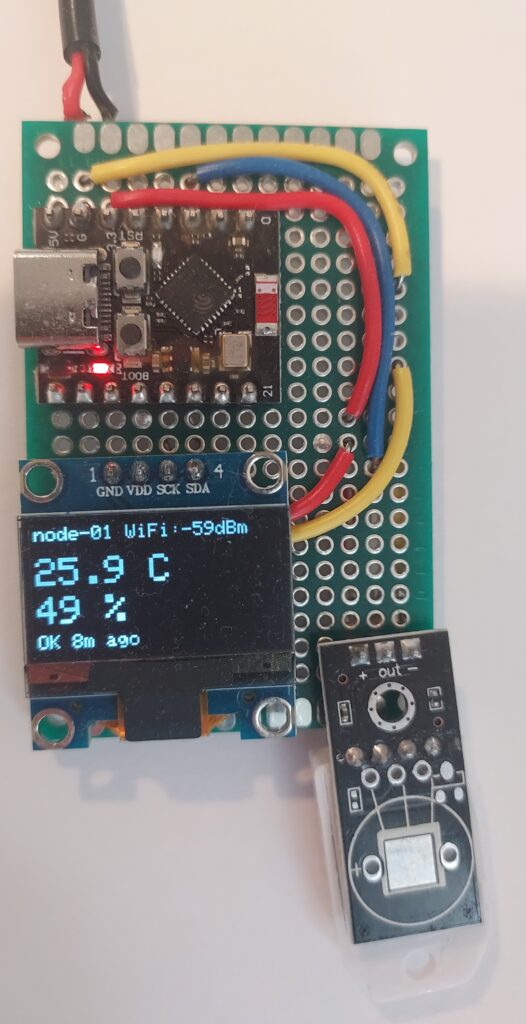
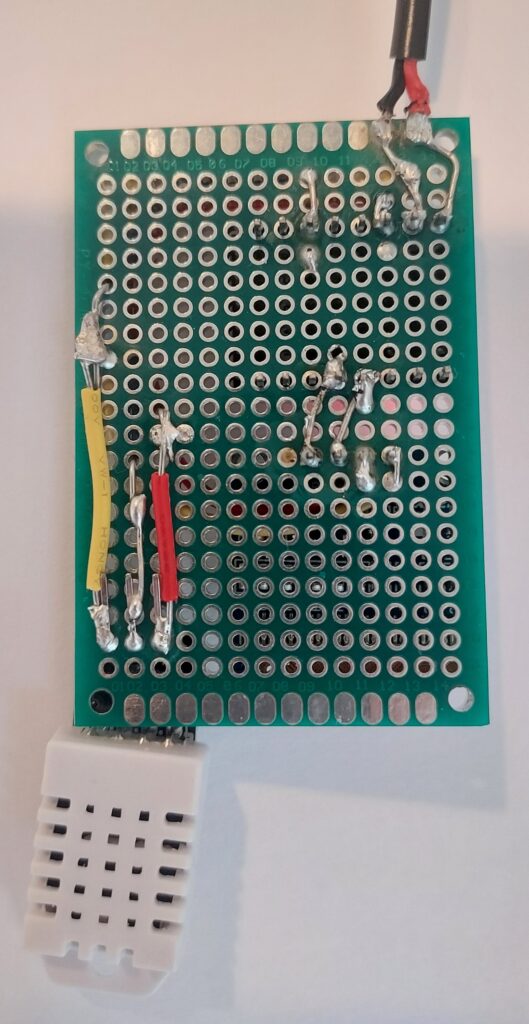
The Bill of Materials
- ESP32-C3 SuperMini: Microcontroller board, the core of the project, handling sensor reads and overall device logic.
- DHT22: Temperature and humidity sensor. The main source of environmental data for the logger.
- OLED display: A compact screen that makes the device useful at a glance by showing live readings directly on the hardware.
- Power and prototyping hardware: Jumper wires, breadboard connections, and a stable USB power source for testing and deployment.
What I appreciate most about this build is that it proves useful hardware does not always need a long parts list. The smaller the design, the easier it is to assemble, power, troubleshoot, and reproduce. That has a direct effect on cost, but it also changes the way I think about the project as a whole. Instead of seeing it as a single gadget, I see it as a repeatable node design. The OLED display adds just enough local usability to make each unit self-contained, while the rest of the system stays simple enough that building several of them still feels realistic.
Final Result
The finished result is a compact environmental monitor that continuously tracks temperature and humidity and shows the readings on an OLED display in real time. What makes it satisfying is not that it tries to do everything, but that it does a small number of things well. It is inexpensive, understandable, and practical. More importantly, it feels like the kind of design that could be repeated across multiple locations without turning into an expensive or hard-to-manage system. For me, that is the real value of this build: not just one working device, but a simple template for many more.This project reminded me that not every successful build needs to be ambitious in the usual sense. Sometimes the smartest design choice is to keep the system small, focused, and repeatable. That approach may look modest on paper, but in practice it opens the door to broader coverage, lower cost, and a much more realistic path to deploying multiple devices where they are actually needed.