Can We Feed the World Without Industrial Agriculture? A Crop Scientist’s Review of Glenn Davis Stone
I recently read Glenn Davis Stone’s The Agricultural Dilemma: How Not to Feed the World. Although I found parts of the book biased, I tried to approach it with an open mind and evaluate its claims as a crop scientist. In this review, I first summarize Dr. Stone’s main arguments and then explain where I agree with him, where I disagree, and why I think modern agriculture cannot be understood without considering breeding, technology, labor, land use, and food security.
Book summary
The cover of the book depicts a man; in his left hand he holds three spikes of wheat and in his right hand there is a burning tree leaf. In the background, there is an endless farm, half harvested with a running combine. The man wears a cap with what appears to be a logo, maybe to illustrate his association with an organization. And that cover picture summarizes Dr. Stone’s view about modern agriculture, what he calls “Industrial Agriculture”.
Dr. Stone begins his discussion by introducing three types of ideas about agriculture:
1- Malthusian theory: Thomas Robert Malthus was an economist in the 1700s. In his article, An Essay on the Principle of Population, he argued that human populations always outgrow agricultural production, creating a gap between supply and demand. The more troubling part of Malthus’s theory is that nature tries to balance that overpopulation by imposing “positive checks” and “vices”. What he really meant by positive checks and vices are diseases, wars and famines that consequently reduce human populations. However, the darker side of this theory is that Malthus called these events “natural means” to put human population in-check. This ideology had horrifying consequences. If adopted by politicians, and Dr Stone claimed it did, any intervention to mitigate those ‘vices’ would be considered unnatural and causes even more misery for a larger population.
Dr. Stone also brought some examples to dismiss Malthus’ theory. He fundamentally denied the core of Malthusian theory that agriculture cannot keep pace with population growth. He brought two examples to dismiss the idea; Ireland’s Great Famine that was triggered by potato blight and British colonial India food shortage. In both examples Dr. Stone argued that exploitation by powerful wealthy British policies caused food-supply crises. In both cases the Irish and Indian farmers were able to provide sufficient agricultural products but due to the faulty system they were exported to Britain’s mainland and left behind the unfortunate colonies.
2- Industrial Agriculture: In Stone’s account, Malthusian thinking helped provide the ideological foundation for modern industrial agriculture. In the third chapter of his book, Dr. Stone argues that industrial agriculture benefited both governments and private companies at the expense of farmers’ well-being. Based on his list, “appropriations” to external industries are the main reason for building and encouraging industrial agriculture. But first what is industrial agriculture? Based on the book, industrial agriculture is a form of agriculture that is dependent on external inputs. And that external inputs cover a broad-spectrum including fertilizers, seeds, genetically modified crops, etc. Based on this definition, industrial agriculture replaced a form of self-contained farming system that was self-sufficient and independent of outside farm inputs. Then he listed those inputs
Fertilizer
At top of Dr. Stone’s list are fertilizers, especially nitrogen fertilizers that have an interwoven history with war-time ammunition factories. In a euphoric self-contained farming system, Stone argues that crops feed the livestock and in return, livestock’s manure is being used to fertilize the crops. However, in 1800s, importing Guano (seabirds’ droppings) from Peruvian islands to distant farms implanted the idea that using external inputs can in fact increase crop yield. According to Stone, that idea gradually led to using factory-made synthetic fertilizers. Later, synthetic fertilizers adopted exponentially by farmers, and according to his interpretation governments played an important role in encouraging fertilizers by using subsidies, sponsoring researchers and selling underpriced manufacturing plants to private sector. Farmers used fertilizers, a lot of fertilizers to feed their crops. And that changed everything, from crops genetics to types of crops being grown in the field. In Stone’s view plant breeders now redesign crops genome to better use synthetic fertilizers. And corn, the most adaptable crops to different management systems, thrived in this new environment at the expense of nitrogen-fixing crops like legumes. And all of this, Dr. Stone concluded, caused over-production, reduced farm output prices and pushed farmers to the verge of bankruptcy. As a result, Stone argues that government jumped in to help, by buying and storing agricultural products, even paying farmers to not to grow crops. Beyond that, he mentioned, over-using chemical fertilizers are associated with environmental costs. Poisonous chemicals are being released to the environment adjacent to the manufacturing plants. In addition, dead zones resulted from over-grown algae feeding from farm-leaked nitrogen.
Breeding
Next on Dr. Stone’s list of external inputs are seeds. Most importantly, the hybrid corn and all the new breeding schema that was encouraged by both public and private breeders. In my reading, Dr. Stone begins the fifth chapter by downplaying the value of formal breeding by highlighting that breeders are not always considering the benefit of farmers and consumers. He argues that some forms of breeding have contributed to diminished nutritional value and taste in food. Stone also links some early plant breeders to eugenic ideas. In Stone’s interpretation, technologies like hybrid corn were not initially devised primarily to increase yield, but to increase farmers’ dependence on commercial seed systems. Stone’s interpretation is that breeders, by keeping the hybrid pedigree secret causing farmers to dependent on breeders seed every season, in contrast to free seeds that are being distributed to farmers or kept by them from last season.
At the core of his thoughts, and the main reason he categorizes seeds as external input is that he believes farmers in fact can run breeding while growing their crops in their farms.
One of his most controversial opinions were about “Green Revolution”. He argued that India did not need a Revolution at all. The huge Indian food import prior to Green Revolution in Stone’s view, was mainly because of Indian government ill policies, prioritizing Industrial developments rather than farming. On the other hand, Stone continues, US wanted to get rid of its own stored grains resulted from over-production so exported them to India. Based on his analysis, food increase in India was well-paced with population growth even before Green Revolution. Stone’s interpretation is that Borlaug’s role has been overstated. In his view, the Green Revolution increased India’s dependence on external inputs such as fertilizers, irrigation, and pesticides rather than simply “saving lives.” In addition, Dr Stone argues that Green Revolution increased wheat production in India in expense of other crops including pulses. Stone argues that even where production increased, farm management and government policy changes played a more important role than Borlaug’s seeds.
3- Third agriculture: At last chapter of his book, Dr. Stone tried to describe a method of agriculture, what he called “intensified agriculture”. Although he was very critical of industrial agriculture in previous sections and provided occasional data, in this chapter I could not see any scientific evidence on how this type of agriculture actually work and compares with other agricultural methods. What he basically described was a multi-crop system that was adopted by Kofyar group in central Nigeria. Kofyar communities run their farms independent of “industrial external inputs”, solely relies on their own labor. This farming system follows a few logics: swidden farming (fire-based), adjustable fallows, and multi-cropping. Soil fertility is being supported by: animal/ human manures, fallows, growing N-fixing legumes and expanding into new parts of forests by controlled burning! Now, he argues that this type of farming is adjusted by population pressure. It means that if population is growing fast AND the farmers are being incentivized, farming can be intensified mainly by shortening the fallow time and burning more forests to keep the soil fertile. But there is no indication that by how much it can be intensified? How much can we reduce fallow and increase invasion to forest territories to catch up with population growth.
My Perspective
Looking back at his claims I can see areas that I agree with him. For example, synthetic fertilizer overuse is a real challenge in modern agriculture. Dead zones in Gulf of Mexico and other parts of the planet are real and primarily caused by fertilizer run-off. He is also right about long-lasting effect of government interference, and the cascade of effects that those policies might have on food supply chain.
However, I do not agree with him on many other points: Mainly the effect of breeding on agriculture. Working as a scientist in both public and private sector, I cannot imagine a world (as we know it today) without crop breeding. I think what Dr Stone tried to undermine in his book was the important role that seeds played in modern agriculture (and in Green Revolution). He put more weight on fertilizers as the sole driver on shaping modern agriculture, but we cannot forget that crop performance is a combination of genetics, environment (management) and their interaction. However, crop production goes beyond these parameters and government policies, international trades and so many other factors come to the picture. Yes, fertilizer was an important factor in performance boost but as modern technologies in breeding, biotechnology, farming mechanization, irrigation, transportation, storage and hundreds of other elements in food supply chain. When we are breeding, we breed a particular seed for specific farming management practices and environment.
As I mentioned earlier, I do agree with Dr. Stone about environmental costs of using and overusing synthetic fertilizers, but I also believe that synthetic fertilizers remain one of the most practical tools currently available for maintaining high yields at global scale. Let’s imagine a world that all farming is being done by “intensified agriculture” as described by Dr. Stone. Even in his book, he emphasizes that this form of farming is labor intensive. You can see that easily by going to your local supermarket and comparing the price tags of organic vs non-organic produce. I did. Yesterday I went to compare it and realized that for a few similar products the price was two to three times higher for organics. Let’s assume we adopt organic farming for all the agricultural products worldwide. We certainly see higher prices everywhere which are not going to be limited to our groceries. It will contribute to inequality in societies with poorer who cannot afford their basic needs. Is that all speculative? No, we experimented with this idea a few years ago. In 2021 Sri Lanka government banned all the chemical fertilizers. A country that was once a rice exporter suddenly faced about 30% reduction in yield and had to import rice for $450 million. This resulted in about 50% inflation in prices, and farmers losing their livelihood. This economic crisis resulted in instability, uprising and change in government. Alternative farming is labor intensive. Even in the US, one of the main concerns of farmers, today, is labor shortage and expense, even in non-organic, mechanized farming. In more labor-intensive farming, like organic, this is more important. What Dr. Stone failed to show was how much more labor do we need to have if we want to keep the prices at the same level as intensified agriculture.
The other point I want to highlight from intensified agriculture is the land needed under higher population pressure. As Dr. Stone described one strategy to keep soil fertile is to re-purpose new lands from forest to farm by burning down the trees and bushes as part of swidden farming. I imagine this short-term “borrowed” lands from forest is not an issue for lower human populations that we had in the past centuries but under high pressures more de-forestation is a necessity and farmers need to keep those farms for longer terms. Dr. Stone failed to quantify how much extra land we need to borrow from forest and for how long we need to keep them. I can imagine that if more land is needed, de-forestation outpaces natural forest restoration and that has an even more adverse environmental impact compared to current modern agriculture.
Providing food for every citizen is a moral requirement of every government. Nobody wants to see a society where its people struggle to provide basic needs like food for themselves and their families. Even now that food is relatively cheap (at least in US), we can see that some citizens rely on food stamps to meet their basic calories. I personally support any policy that brings more inexpensive food for the vast majority of people, that causes equality to meet basic needs. However, food security is a more complex topic and beyond the scope of this review. When we talk about food security other factors like food waste and distribution need to be discussed.
The last point I want to highlight from the book is Dr. Stone effort to separate farming from other aspects of modern human societies. Today, physicians are using technologies that are developed by other disciplines to diagnose and manage human diseases. MRI, CT-Scans, robotic-surgeries, and medications are a few examples that help modern medicines to improve human well-being. We cannot ignore these technologies by labeling them as “external”. Technology today is part of life. They are not perfect, but they improve our quality of life.
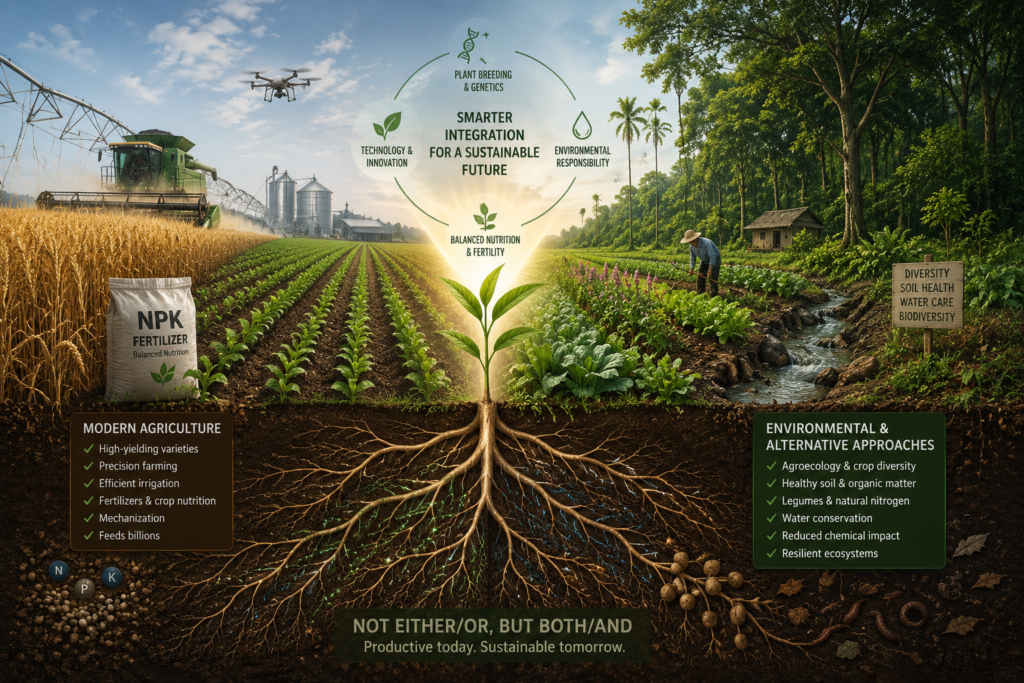
Overall, Stone’s book is valuable because it challenges readers to think critically about the political, economic, and environmental costs of modern agriculture. I agree that fertilizer overuse, poorly designed policies, and dependence on external inputs deserve serious scrutiny. However, I am not convinced that intensified, low-input agriculture can replace modern systems at the scale required to feed today’s population. The better path is not to reject breeding, fertilizers, or technology, but to use them more intelligently, more efficiently, and with greater attention to environmental and social costs.